Opens in a new tab
Bolzenschweißtechnik bsk + BTV GmbH
Send inquiry
Technical information →

Technical information

Knowledge for reliable joints: processes, materials, technical values and practical advice for stud welding.

The three welding processes

Capacitor discharge, short-cycle and drawn arc stud welding: process sequences, applications and technical differences.
Explore processes →
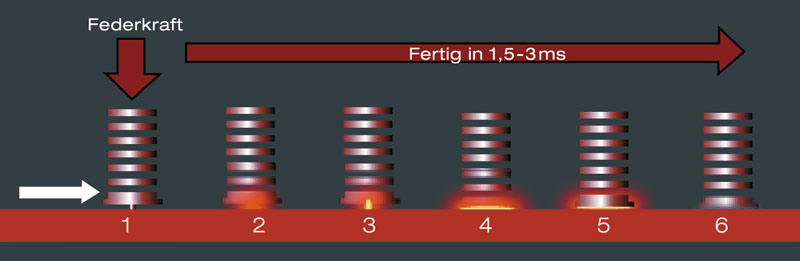
Sequence of capacitor discharge contact stud welding

Processes & materials

Stud welding overview

Stud welding joins metallic fastening elements to a base material. Here you will find an introduction to processes, materials, design and applications.
Read technical information →

Stud welding basics explained simply

What is stud welding, how does it work and where is it used? Answers to the fundamental questions.
Read technical information →

The three welding processes

Capacitor discharge, short-cycle and drawn arc stud welding: process sequences, applications and technical differences.
Read technical information →

Material combinations for stud welding

Which materials can be joined? The original tables show material combinations for capacitor discharge welding as well as drawn arc and short-cycle drawn arc welding.
Read technical information →

Stud welding on different materials

Guidance on stud welding on steel, stainless steel, aluminium, brass and coated surfaces.
Read technical information →

Design & technical values

Assembly tightening torques for stud welding

Assembly tightening torques for steel, stainless steel and aluminium welding studs in the existing technical overview.
Read technical information →

Strength values of welding elements

Mechanical properties of welding elements: materials, applicable standards, tensile strength, yield strength and elongation at break.
Read technical information →

Welding studs and welding elements

Threaded studs, bushings, pins and other welding elements: designs, materials, designations and applications.
Read technical information →

Stud welding solves common fastening problems

Fastening without drilling or thread cutting: processes, component access, surfaces and automation.
Read technical information →

Quality & safe practice

Stud welding checklist

Checkpoints for occupational safety, operating personnel, welding guns, power sources, cables, workpieces and trial welding.
Read technical information →

DIN standards and DVS information sheets

Standards and DVS information sheets for selecting, executing, inspecting and documenting stud welded joints.
Read technical information →

Quality, inspection and standards in stud welding

Applicable standards, inspection methods and typical factors influencing the quality of stud-welded joints.
Read technical information →

Systems & applications

Stud welders for every application

Selection criteria for stud welders – from workshops and construction sites to automated production.
Read technical information →

The right stud welding gun for every process

Welding guns for capacitor discharge welding, drawn arc welding and automatic feeding: selection by process and application.
Read technical information →

Stud welding by industry and application

Applications in structural steelwork, vehicle construction, control cabinet construction, mechanical engineering and other industries.
Read technical information →

CNC stud welding and automatic stud welding

CNC systems, welding heads and feeding technology for automated stud welding processes.
Read technical information →

Press-fit elements and press-fit technology

Press-fit elements and press-fit technology as a fastening solution for thin sheets.
Read technical information →

Buying stud welding technology: solutions for buyers & planners

Selection and procurement of welding studs, welding equipment and automated solutions.
Read technical information →

Stud welding expertise: comparisons & practical tips

Comparisons with other fastening processes and answers to questions from industrial practice.
Read technical information →

Your application. Our experience.

Discuss your application →